What Is a Blockchain RPC Node and How It Works
Why Do dApps Actually Work When You Click “Send”?
Most people using crypto wallets or trading on DEXes don’t think twice about what happens when they hit a button. But behind every balance check, every transaction broadcast, every liquidity pool query sits something called an RPC node (Remote Procedure Call node).
We’ve been running blockchain infrastructure since 2016 — nearly a decade now — and RPC nodes are both the unsung heroes and the recurring bottleneck of Web3.
An RPC node is a specialized blockchain server that acts as a communication bridge between applications (wallets, dApps, explorers) and the blockchain itself. It lets developers query on-chain data or submit transactions without forcing every user to run a full node locally, which would be absurdly heavy for most devices.
In a QuickNode case study, Monad scaled to 40B+ monthly requests, illustrating how RPC infrastructure becomes a bottleneck at scale. Poor RPC performance causes slow UIs, failed trades, and frustrated users, so enterprises now build dedicated RPC layers with 99.9% to 99.99% uptime guarantees.
As an RPC endpoint provider, managed RPC infrastructure typically spans multiple continents with distributed nodes specifically designed to hit 99.9%+ uptime targets, because the demand for high-performance, low-latency endpoints has become impossible to ignore.
How RPC Nodes Actually Work
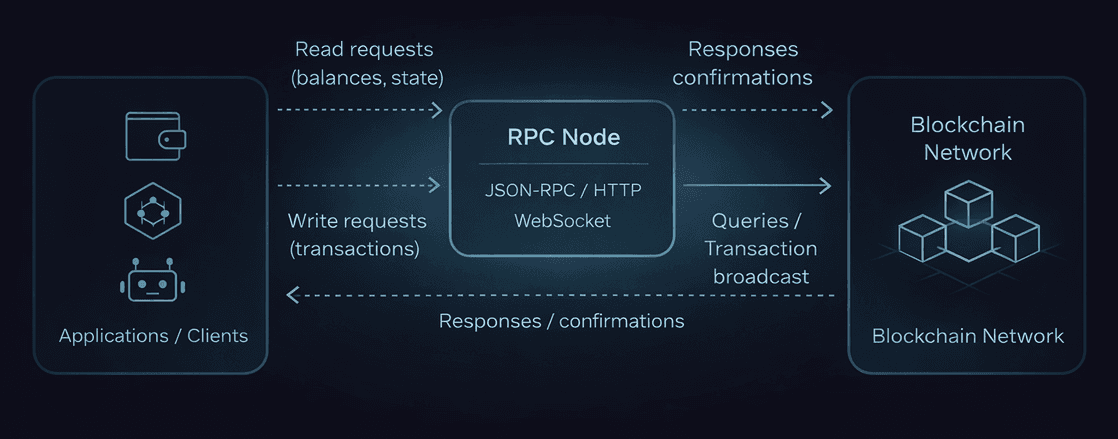
An RPC node is a server that accepts requests via APIs — usually JSON-RPC — to read blockchain state or submit transactions.
Think of it as an API gateway where applications call methods like getBalance or sendTransaction, and the node responds with on-chain data or broadcasts the transaction to the network.
In practice, the flow looks like this:
- An application sends an RPC request (for example, “get token balance” or “submit transaction”)
- The RPC node parses the request, validates it, and queries its local blockchain database
- The node compiles the response and sends it back — often within milliseconds
From an operational standpoint, RPC nodes are optimized for high query throughput, not consensus participation. Full nodes validate blocks; RPC nodes typically mirror chain state and answer queries without producing blocks.
Most blockchains use JSON-RPC over HTTP(S), while others — such as Solana — rely on gRPC or WebSocket endpoints for real-time subscriptions.
Public RPC endpoints usually enforce rate limits or API keys to prevent abuse. Dedicated RPC services provide private endpoints with guaranteed resources and no shared limits.
Types of RPC Endpoints
Full, Archive, and Light Nodes
- Full nodes store the full blockchain and answer current-state queries
- Archive nodes keep complete historical state, required for deep analytics and historical queries
- Light nodes store partial data and rely on full nodes for missing information
Production RPC providers usually support all three. A wallet may only need current balances, while analytics platforms require years of historical logs.
Shared vs. Dedicated RPC
Shared RPC nodes serve multiple clients on the same infrastructure. This introduces noisy neighbor risk, where one heavy workload degrades performance for everyone else.
Dedicated RPC services provide isolated hardware and bandwidth for a single tenant. QuickNode describes this as “complete isolation… eliminating any noisy neighbor effect.” This distinction matters when running high-frequency trading bots, indexers, or mission-critical applications that cannot tolerate latency spikes.
Real-World Use Cases
dApps and Wallets
Every wallet and decentralized application relies on RPC calls to fetch balances, read smart contract state, and submit transactions. When RPC fails, the UI fails.
DeFi and Trading
DeFi protocols require real-time chain data. Lending platforms calculate rates based on reserves, DEXes price swaps using live liquidity, and traders depend on millisecond-level accuracy.
QuickNode reports serving protocols managing $50B+ TVL across 70+ networks, and RPCFast advertises sub-4ms latency on optimized Solana nodes. In practice, latency variance (jitter) often matters more than average latency — a single slow request can kill a trade.
Indexers and Analytics
Blockchain explorers and analytics platforms crawl chain data using thousands of RPC requests per second. Full indexer nodes and custom data pipelines sit alongside RPC to avoid hammering endpoints with millions of individual queries.
Performance and Infrastructure Considerations
Latency and Throughput
Latency measures response time; throughput measures requests per second. At scale, even a few extra milliseconds per request compound into serious system-wide delays.
Global Distribution
Geographic distribution reduces latency and increases resilience. Providers like QuickNode emphasize global traffic routing with automatic regional failover, while production-grade RPC networks deploy nodes across North America, Europe, and APAC.
From experience, having nodes on every major continent makes a real, measurable difference for global users.
Workload Isolation
Running validators or indexers on shared infrastructure is risky. We’ve seen indexers overload nodes so badly that validators missed attestations. Production-grade RPC relies on containerized clusters, horizontal scaling, and strict isolation.
Isolation is not optional for high-stakes systems.
Caching and Uptime
Caching repeated queries reduces load and improves responsiveness. Providers like Infura integrate caching and reorg detection, while others combine RPC with indexers for complex queries.
Uptime is critical. QuickNode offers 99.99% SLA, while HighTower guarantees 99.9% uptime with 24/7 AI monitoring. Achieving even 99.9% requires redundancy — single-node setups will fail eventually.
Why RPC Infrastructure Matters
RPC nodes may feel like backend plumbing, but they are what makes crypto usable.
Without reliable, low-latency RPC:
- Wallets freeze
- DeFi protocols display stale data
- Trading bots miss execution windows
We’ve been building and maintaining this infrastructure since 2016 across Bitcoin L2s, EVM chains, and Solana. The conclusion is simple: RPC performance directly impacts user experience and business outcomes.
Whether you’re launching a new dApp or scaling an existing protocol, choosing the right RPC strategy — dedicated endpoints, global distribution, or infrastructure partnerships — is one of those decisions that determines whether you scale smoothly or spend the next six months firefighting outages.


.png&w=3840&q=75)