Blockchain Data Solutions: Building Reliable RPC and Indexer Infrastructure for Modern dApps
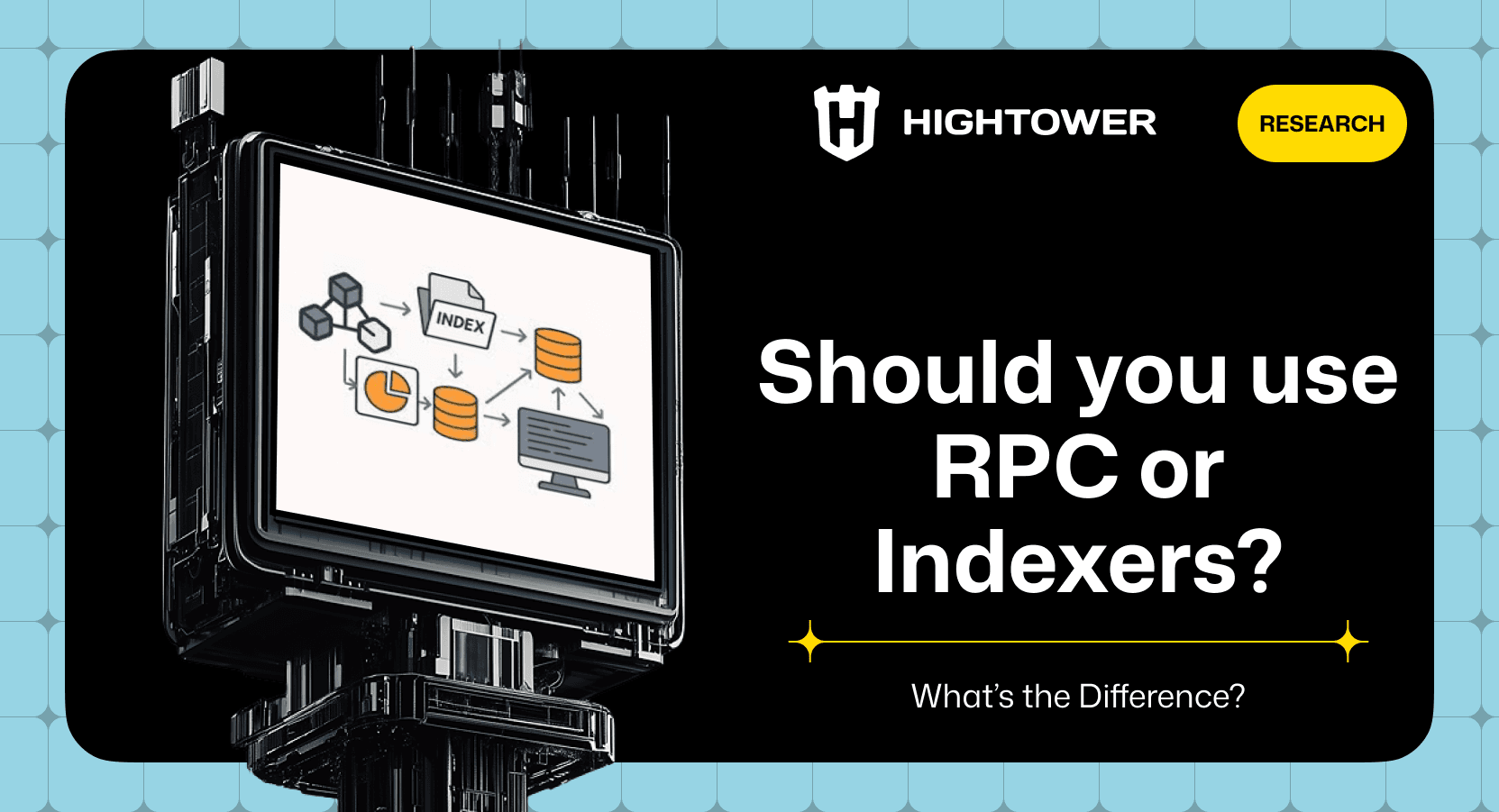
Modern decentralized applications are only as powerful as the data infrastructure behind them.
Wallets, trading platforms, analytics dashboards, DeFi protocols — all of them depend on fast access to blockchain data.
That access is delivered through two critical layers:
- RPC endpoints for real-time communication
- Indexers for structured, queryable blockchain data
At HighTower, we operate both at scale — across multiple networks — and we’ve learned that data architecture is what separates stable dApps from fragile ones.
The Foundation: Full Nodes
Everything starts with a full node.
A full node stores blockchain history, validates blocks, and enforces consensus rules. Without full nodes, there is no trustless infrastructure.
However, full nodes are not optimized for high-volume application queries. They are designed for validation, not analytics.
That’s where RPC and indexers come in.
RPC Endpoints: The Real-Time Access Layer
RPC (Remote Procedure Call) endpoints allow dApps to:
- Broadcast transactions
- Fetch balances
- Read smart contract state
- Monitor mempool activity
- Query block data
Every time a user interacts with a dApp, an RPC request is triggered.
Why Dedicated RPC Matters
Public RPC endpoints are often:
- Rate-limited
- Overloaded
- Shared between thousands of applications
For production dApps, that’s a risk.
At HighTower, we provide:
- Dedicated RPC nodes
- Load-balanced infrastructure
- High uptime guarantees
- Performance monitoring
- Optimized query routing
Our RPC infrastructure is built to handle sustained traffic — not just occasional queries.
Indexers: Making Blockchain Data Usable
Raw blockchain data is difficult to query efficiently.
Full nodes expose low-level data structures, but complex queries (like transaction history by wallet, token analytics, or protocol-level metrics) are slow and resource-intensive without indexing.
That’s why serious dApps rely on indexers.
What Indexers Actually Do
Indexers:
- Extract blockchain data from full nodes
- Transform and structure it
- Store it in optimized databases
- Enable fast, complex queries
Without indexers, analytics platforms and high-frequency applications simply don’t scale.
HighTower Indexers: Built on ClickHouse
At HighTower, we operate multiple indexers across different networks and data domains.
Our architecture includes:
- High-performance data ingestion pipelines
- Multiple specialized indexers (transactions, tokens, smart contracts, mempool data, etc.)
- ClickHouse-powered storage for analytical workloads
Why ClickHouse?
Because blockchain data is massive, fast-moving, and query-heavy.
ClickHouse allows us to:
- Execute complex analytical queries in milliseconds
- Handle billions of rows efficiently
- Support real-time dashboards and API layers
- Scale horizontally as data grows
Instead of relying on a single generic indexer, we maintain multiple purpose-built indexers, optimized for different use cases and chains.
This enables:
- Lower latency
- Better fault isolation
- More granular scaling
- Custom API layers for partners
How It All Works Together
A production-ready blockchain data stack typically looks like this:
- Full Nodes — validate and store blockchain data
- Dedicated RPC Endpoints — expose real-time access
- Indexers (ClickHouse-backed) — structure and optimize data
- API Layer — deliver fast, developer-friendly responses
By separating concerns across these layers, we ensure performance, reliability, and scalability.
Why This Matters for dApps
Poor infrastructure leads to:
- Failed transactions
- Slow balance updates
- Inaccurate analytics
- Rate-limit issues
- Unstable APIs
Reliable RPC and properly designed indexers eliminate these bottlenecks.
For high-traffic dApps, trading systems, wallets, or data platforms, infrastructure isn’t just backend plumbing — it’s a competitive advantage.
Blockchain Data Solutions Built for Scale
At HighTower, we don’t just run nodes.
We operate a distributed data infrastructure stack:
- Multi-network full nodes
- Dedicated RPC endpoints
- Multiple specialized indexers
- ClickHouse-based analytics storage
- Custom data pipelines
This allows our partners to build dApps without worrying about performance ceilings or infrastructure instability.
Because in blockchain, speed and reliability aren’t optional — they’re foundational.
If you're building a dApp, analytics platform, or trading system, the question isn’t whether you need reliable RPC and indexers.
The question is whether your current infrastructure can scale when your users do.